The Best Wood For Kitchen Cabinets

Updated: 18 minutes ago
The best wood for your kitchen cabinets is simply the one that suits your design, within a few practical guidelines. Every species brings its own personality: open-grained woods like oak and hickory have a lively, pronounced texture, while closed-grain woods like cherry and maple have a softer, quieter look. There are a few things worth weighing before you choose, starting with hardwoods versus softwoods.

It is generally best to stay within hardwoods (maple, white oak, red oak, cherry, walnut, hickory, birch, and alder are most common in North America), as opposed to softwoods (basically any tree with a needle: fir, spruce, pine, etc). The latter species are comparatively soft and may damage more easily.
Virtually every domestic hardwood used to make cabinetry in the US is durable, stable, and built to handle decades of daily use in a kitchen. Because most of those woods offer about the same in durability, it really comes down to two specific decisions: your finish choice, meaning paint versus stain, and the grain pattern you want to see in your space.
Janka Hardness Scale
The Janka hardness scale is the industry standard used to measure how resistant wood is to denting and indentation. It measure the force required to embed a steel ball halfway into a wood sample.

So, for the absolute best wood specifically against denting, hickory and white oak are your best bets. That said, if good, professional-grade finishes are being used, you'll be okay using any hardwood listed above, or mentioned in this blog, with the exception of maybe pine/fir (both are used often in certain design aesthetics, but are certainly on the softer side).
First Question: Paint vs. Stain?
Before picking a wood species, you need to decide whether the cabinets will be painted or stained. That single choice immediately narrows your material options.

If you want smooth, painted cabinetry, paying a premium for figure or heavy wood grain is unnecessary. The goal is a dense, closed-grain hardwood that will not show texture through the finish. Maple is the industry standard for painted doors and face frames because its tight grain creates a completely smooth substrate for the finish. Paint-grade birch and poplar are also widely used for door frames, face frames, and cabinet components.
For painted door center panels, cabinet-grade MDF is often preferred over solid wood. High-quality MDF remains dimensionally stable, eliminating the seasonal wood movement often seen in solid wood.
Open-grained woods like Oak or Walnut are rarely used for smooth painted finishes unless a heavy, raised-grain texture is deliberately desired through the paint.
We just published a complete guide on the best materials for painted cabinets, if you'd like to read more!
Why Grain Pattern Drives Wood Selection
If you plan to use a stained or clear natural finish, the choice of wood comes down to aesthetic texture and grain orientation. Two species can take the exact same stain color and look entirely different based on their grain density and how the log was milled. We're going to use these examples from Diamond cabinetry because they do a fantastic job of showing the different wood grains, all in the exact same finish. Important note: we have no affiliation with Diamond, and using them in this blog is not an endorsement (I do not personally know their product well enough to give a genuine up or down vote).

For clean, uniform surfaces where the color remains consistent and the wood pattern is muted, closed-grain hardwoods are ideal. Maple offers a tight, fine grain pattern, and cherry is known for its smooth, flowing grain and natural warm undertones, naturally deepening in color over time as it is exposed to natural light to develop a rich patina. Alder is a popular option in custom and semi-custom cabinetry due to its fine, uniform grain structure.

If you want distinct visual texture, pronounced grain lines, or organic movement across your cabinet fronts, open-pored hardwoods deliver that depth. Standard flat-sawn oak yields prominent, arched cathedral grain patterns where stain settles deeper into the open pores to create a high-contrast appearance. By changing the angle of the cut relative to the tree's growth rings, rift-sawn and quarter-sawn white oak eliminate those sweeping arches, resulting in a clean, vertical, straight grain pattern with high dimensional stability common in modern and transitional kitchen design (we have an in-depth guide into oak here if you'd like to read more).

Hickory sits on the extreme end of texture, known for heavy grain structure and extreme natural contrast that blends light cream sapwood and dark brown heartwood on the same panel.
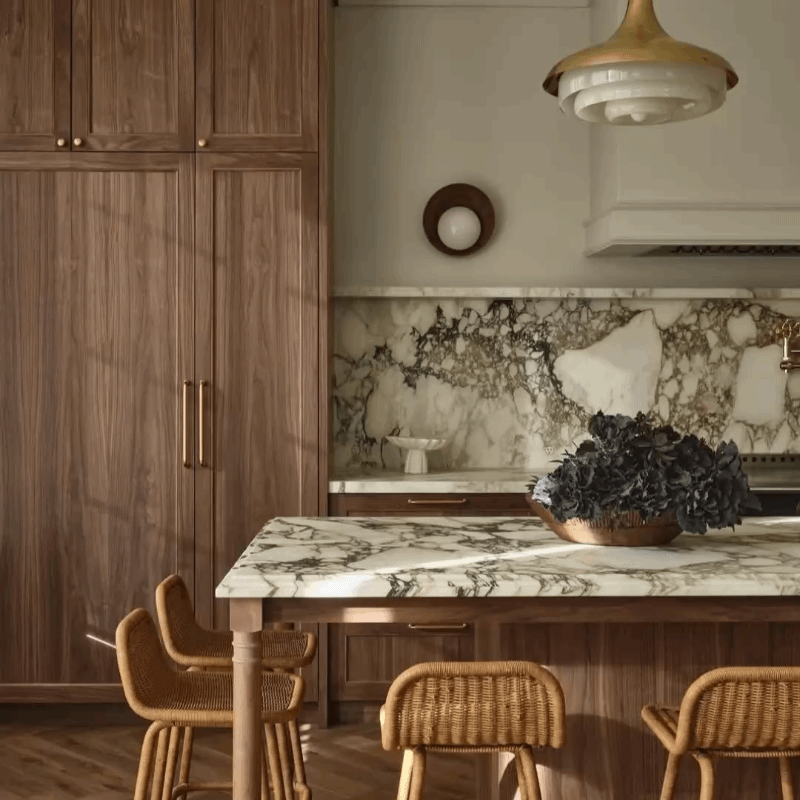
Walnut, while beautiful, also has a very loud grain pattern, a dark brown natural tone, and quite a bit of color variation. We have our full in-depth walnut guide here.
Not Sure What Wood is Used in Your Inspo Photo?
Try our new visual search! Just upload any inspo photo (even AI images), and see not only the exact wood and stain needed to create that look, but the actual cabinet companies to buy from.
The visual search is on our new marketplace Find A Cabinetmaker, to be connected with the best custom cabinetmakers in North America.
Frequently Asked Questions
What is the best wood for kitchen cabinets?
The best wood for kitchen cabinets depends on the look you want to achieve. Maple offers a subtle, uniform grain, white oak has a pronounced grain pattern, cherry brings warm tones, and walnut offers rich color and natural variation. Your choice should depend on your preferred finish, grain pattern, and kitchen design.
What is the most durable wood for kitchen cabinets?
Most domestic hardwoods used for kitchen cabinets, including maple, oak, cherry, walnut, and hickory, are durable enough for decades of everyday use when properly constructed and finished. For greater resistance to dents and indentation, hickory and white oak are excellent choices because of their high Janka hardness ratings.
What is the best wood for painted kitchen cabinets?
Hard maple is one of the best woods for painted kitchen cabinets because its tight grain creates a smooth surface for paint. Birch and poplar are also common paint-grade options. MDF is often preferred for painted Shaker cabinet door center panels because its dimensional stability helps reduce hairline cracks in the paint at joints.
What is the best wood for stained kitchen cabinets?
The best wood for stained kitchen cabinets depends on your preferred grain and color. White oak creates bold, pronounced grain patterns, maple offers a more subtle appearance, cherry develops warm tones over time, and walnut features rich brown coloring and natural variation. Alder is another option for a softer, more uniform grain.
Does the same stain look different on different types of wood?
Yes. The same stain color can look very different on different wood species because of their natural color, grain pattern, and pore structure. For example, oak's open grain creates more contrast, while maple typically produces a more uniform appearance. Always compare samples of the actual wood and stain combination before choosing your kitchen cabinets.
Is white oak or maple better for kitchen cabinets?
White oak and maple are both excellent choices for kitchen cabinets, but they create different looks. Maple has a fine, subtle grain that works well for understated designs and painted finishes. White oak has more pronounced grain and is popular for natural and stained cabinetry, particularly in modern and transitional kitchens.
The Value of Unbiased Advice
Having a partner early in the process to help identify red flags, walk you through what the process should look like, and help vet the other professionals on your project is exactly why we created this community. We understand that you're not just building a house, you're creating a home, and every detail has to be perfect.

Whether it's our blog, free expert advice in our Facebook group, our Cabinet Buyers Guide and Checklist, or to be connected with top cabinetmakers at our new site Find A Cabinetmaker, we're here to help you every step of the way.
Here's to empowered homeowners!


